
How are vector graphics being integrated with 3D modeling, AR, and VR?
With the advancement of technology, the integration of vector graphics with 3D modeling, augmented reality (AR), and virtual reality (VR) has emerged as a pivotal trend in digital design and development. This union not only enhances visual creativity but also opens up new avenues for interactive and immersive experiences across various sectors including gaming, education, and digital marketing.
Vector Graphics in 3D Modeling
Vector graphics have revolutionized 3D modeling by providing scalable and precise designs that can be manipulated without loss of quality. This capability is particularly valuable in industries such as architecture and industrial design where precision and detail are paramount. In 3D modeling, vector graphics are often used to create textures and meshes that can be easily adjusted and rendered into high-quality models. The infusion of vector graphics into 3D modeling allows designers to maintain flexibility and accuracy during the design process.
Enhancing AR Experiences with Vector Graphics
In the realm of augmented reality, vector graphics play a critical role in improving user interaction and enhancing visual appeal. Since AR involves overlaying digital content on the real world, vector graphics help in creating sharp and vibrant visuals that appear seamlessly integrated into the physical environment. These graphics are used to design interfaces and animations that engage users effectively. The ability to scale vector images without compromising quality makes them ideal for AR applications, where they are often used in educational tools, marketing campaigns, and entertainment software to create dynamic and engaging user experiences.
VR and the Role of Vector Graphics
Creating Immersive Environments
In virtual reality, creating immersive environments is key, and vector graphics serve as an essential tool to achieve this. Their scalability means that environments can be expanded or contracted to fit various scenarios without losing definition and crispness. Vector graphics are used to construct both foreground and background elements in VR, ensuring that users receive a high level of detail as they interact with virtual spaces. Through vector-based designs, developers can produce intricate visual effects and environments that enhance the overall realism and immersion of the VR experience.
Interactive Design in VR
Additionally, vector graphics facilitate effective interactive design within VR applications. Elements such as user interfaces, control panels, and interactive maps are frequently designed using vectors because they need to be flexible and responsive to user inputs. Vectors enable creators to design engaging interactive elements that can adjust and respond fluidly to user movements and preferences.
Integration Challenges and Solutions
Despite their advantages, integrating vector graphics with 3D, AR, and VR technologies presents several challenges. One of the main difficulties is the requirement for high computational power due to the complex processes involved in rendering vector images in three-dimensional space. However, advancements in technology and rendering software are continually providing solutions that enable smoother and more efficient integration of these graphics.
The Role of Eagle Digitizing
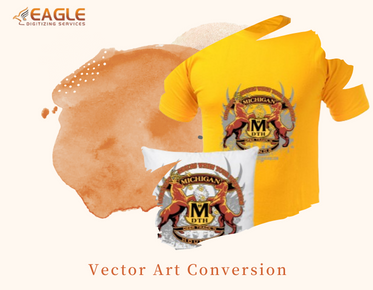
In this evolving landscape, services like those offered by Eagle Digitizing are pivotal. They provide vector art services that are tailored for various applications, including 3D modeling, AR, and VR. By ensuring high-quality conversion and precise design, such services support the intricate demands of modern digital design projects.
Future Directions
Looking ahead, the integration of vector graphics with 3D modeling, AR, and VR is set to increase as technology develops and new applications emerge. Future innovations may focus on enhancing the realism of virtual environments, improving the interactivity of AR elements, and streamlining the design process for complex 3D models. As these fields continue to evolve, vector graphics will undoubtedly remain a cornerstone of digital design and development.
The exploration of vector graphics in 3D, AR, and VR opens up numerous possibilities for creative and interactive digital experiences. As these technologies advance, the potential for customization and innovation will only grow, inviting designers and developers to push the boundaries of what's possible in digital art.