
When Preserving Imperfection Matters More Than Clean Geometry
The Art of Authenticity: Celebrating Imperfect Details
In a digital world obsessed with flawless lines and mathematical precision, there’s a growing movement that challenges the norm—one that values imperfection as much as perfection. Whether in visual art, branding, product design, or digital illustration, the human touch—the off-balance stroke, the unexpectedly jagged edge, the minute variation in hue—can evoke emotions that sterile geometry often cannot. For many designers, marketers, and entrepreneurs, embracing these “imperfections” creates a sense of authenticity and tells a deeper story about a brand, a product, or a piece of visual communication.
Understanding Clean Geometry and Why It Became the Default
The rise of software and vector-based tools has empowered creators worldwide to generate graphics that are infinitely scalable, razor-sharp, and visually consistent. Clean geometry is synonymous with professionalism in many contexts: logos with perfect symmetry, icons with crisp corners, and layouts with mathematically precise spacing are staples of modern branding. For industries like vector conversion service providers, the ability to offer clean, reproducible lines in every design is a central selling point. However, as much as this speaks to quality, it can sometimes strip the soul from visual work—especially when the aim is to resonate emotionally or tell a story rooted in tradition or crafted originality.
When Imperfection Steals the Show
Relatability Over Perfection
There is a reason why hand-drawn sketches, vintage prints, and rough-cut patterns never truly go out of style. They reflect the quirks of the creative mind and the tactile richness of real life. Brands seeking to stand out from the white noise of digital sameness are increasingly opting for vector art services online that celebrate irregularities. These subtle flaws can be as impactful as a cleverly written tagline—sometimes even more so, forming instant connections with viewers.
Preserving Legacy: Emotional Impact in Branding
Consider the beloved local bakery with a slightly askew illustration of a loaf, or a craft brewery using a hand-lettered logo on every bottle. These visual “blemishes” often become a brand’s signature, a signal of heritage and commitment to craft. Such subtleties can rarely be replicated through automatic tracing or standardized templates; they often require an expert, empathetic hand able to recognize what makes a piece unique and worth preserving.
In marketing, this authenticity builds trust. Consumers today are hyper-aware of mass-production and automation—so when they see a rough edge or a playful imperfection, it feels more relatable and genuine.
Eagle Digitizing: Merging Craftsmanship with Digital Excellence
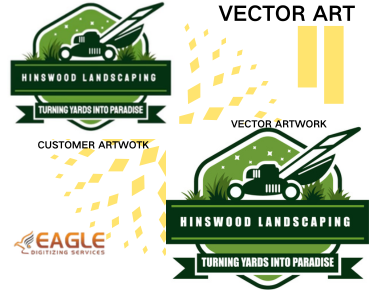
Companies like Eagle Digitizing have long recognized the importance of both clean geometry and authenticity. Their vector art services are designed not just for speed and scalability but to maintain the heart of the original artwork. Through a blend of advanced technology and artisanal finesse, their team can convert even the most intricate and unconventional designs—think faded family photographs or hand-drawn doodles—into print-ready files that honor the original’s personality.
Eagle Digitizing’s commitment to customer satisfaction stems from a deep appreciation for each client’s vision. Their team adapts to projects ranging from promotional banners intended for mass production to custom t-shirt stores wanting every print to feel unique. They specialize in converting raster images to graceful vector art, offering expert color separation, shadow optimization, and photo restoration—all while valuing the legacy embedded in imperfect details. This approach ensures that businesses, whether small or midsize, can access affordable, rapid-turnaround vector conversion without sacrificing material authenticity.
Technical Challenges in Imperfect Vectorization
Translating imperfection into the language of vectors is both an art and a science. Standard automation tools tend to flatten nuances, erasing the very subtleties that give a design its soul. The artistry lies in distinguishing between what should be “corrected” and what is best left as-is. Advanced professionals in the vector art conversion company arena understand that it’s often the slight inconsistencies—a line that wobbles, a color that spills, a letterform that breaks symmetry—that make a brand mark unforgettable.
This has given rise to specialized vectorization services capable of nuanced, hand-guided interpretation. Rather than focusing solely on mathematical perfection, these specialists recreate the feel and energy of the source material, balancing technical quality with creative intuition.
Handcrafted Vectorization for Meaningful Storytelling
Sometimes, a logo or illustration represents more than just a business. It’s a family legacy, a memory, or a story passed down through generations. Handcrafted conversion preserves the delicate lines of an old drawing or the rugged shadows of a weathered sign, translating them for use in digital marketing, packaging, and merchandise. For artists, marketers, and small businesses, this preservation ensures that their story remains whole and distinctive, even as it moves seamlessly from physical to digital and back again.
Aesthetics of Imperfection Across Industries
From tattoo design to bespoke packaging, industries are re-discovering the commercial and creative value of imperfection. In the fashion world, hand-drawn patterns stand out against countless mass-produced alternatives. In print shops, locally-run businesses attract customers by conveying personality through hand-crafted graphics and signage. Eagle Digitizing tailors its solutions to a spectrum of clients, understanding that not every design needs to be “fixed.” Their work in vectorizing artwork highlights the beautiful variation possible when the unique lines and forms of original art are preserved.
Even large marketing agencies and graphic designers, once committed strictly to clean geometry, are beginning to commission “imperfect” digital assets that better reflect the pulse of their target communities.
Audience Response and Brand Differentiation
Today’s consumers crave authenticity, and their appreciation for imperfection is evident in the marketplace. Social media campaigns that showcase behind-the-scenes sketches, early logo drafts, or design “mistakes” often generate higher engagement than polished launch graphics. Small businesses using artwork vectorization service find that their stories and products resonate longer with audiences, making a memorable first impression with every touchpoint.
Maintaining Balance: When and How to Embrace Imperfection
Not every project benefits from the deliberate preservation of imperfection, but knowing when to do so is its own form of expertise. For healthcare branding, clean geometry might communicate trustworthiness and sterility. In contrast, a children’s boutique or artisan chocolatier may find that wobbly lines and playful shapes charm customers in ways rigid designs simply cannot.
The key to success lies in reading the project’s narrative, understanding the intended audience, and deploying a blend of scientific technique and artistic interpretation. Companies engaging with experienced providers in vectorizing services benefit from the insight and flexibility necessary to interpret both the desired aesthetic and the brand’s core values.
Experienced teams can consult on when and how to guide imperfection—ensuring consistency for brand applications that require it, but allowing organic beauty when authenticity matters more.
Looking Ahead: The Future of Imperfect Design
As digital environments become ever more polished and automated, we can expect the pendulum to keep swinging back toward authenticity. The next wave of branding and illustration will likely blur the boundaries between mathematical precision and expressive human creativity. Emerging AI tools, for instance, are already exploring how to simulate hand-drawn imperfections at scale, marrying efficiency with emotional depth.
For creators, brands, and service providers, the conversation about perfection versus imperfection is far from over. The challenge—and opportunity—lies in not just mastering the tools, but in telling honest, resonant stories that celebrate what makes each piece, project, or product truly one-of-a-kind.
As you consider your next brand refresh, illustration project, or marketing campaign, ask yourself: Is perfection the goal—or could your audience fall in love with something a little less polished, a little more human?