.png "vector art service")

Why Does a Vector Logo Stay Sharp When Enlarged While a JPG Becomes Blurry?
In the world of digital graphics, there lies a fundamental distinction between two primary types of images: vector graphics and raster graphics such as JPGs. This difference becomes distinctly apparent when resizing images. A vector logo retains its sharpness no matter how much you enlarge it, while a JPG becomes blurry. This phenomenon is rooted in the fundamental ways that these image formats store and manage visual data.
Understanding Raster Graphics
Raster graphics, including formats like JPG, PNG, and BMP, are comprised of a grid of individual pixels. Each pixel holds a specific color value. The clarity or quality of a raster image is directly tied to its resolution - more pixels equate to more detail, creating a clearer image at its native size. However, when you scale up a JPG, you are essentially stretching the pixels, causing the edges and details to blur as the pixels become increasingly visible.
Raster images are ideal for capturing rich, complex detail in photographs. However, this comes at the cost of scalability, as increasing the size of the image also increases the pixelation and blurriness. Thus, while JPGs are perfect for detailed and vibrant photography, they aren't favorable for logos or designs which need to be printed in various sizes.
The Vector Graphics Solution
Vector graphics, however, operate on a completely different principle. These images are created using mathematical equations to define paths, curves, colors, and shapes. Unlike a raster graphic's dependency on pixels, a vector's quality remains consistent at any size because it is composed of paths controlled by mathematical expressions. As you resize a vector image, these mathematical expressions can adapt seamlessly, maintaining the image's clarity and crispness.
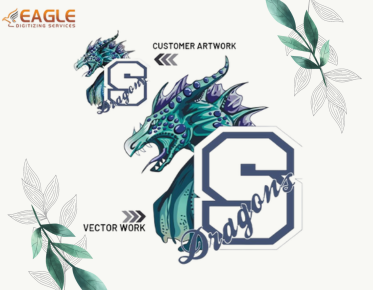
This scalability makes vector logos an excellent choice for brand identities, as they can be adapted to fit on anything from a business card to a billboard without losing any detail. Vector logos conversion is a popular service among businesses that aim for consistency in brand presentation across all mediums.
Why Choose Vector Graphics?
For businesses and designers, the benefits of using vector graphics for logos are significant. They allow for the highest quality print reproduction, suitable for all forms of printing—screen printing, embroidery, laser cutting, and more. Companies like Eagle Digitizing take advantage of the high precision of vector graphics to ensure each design detail is captured accurately.
Eagle Digitizing, for instance, provides specialized services such as vectorizing and converting logos into scalable vector formats. They are known for transforming intricate designs into clean, scalable graphics that stay true to the original artwork, making them an invaluable partner for businesses that require reliable vector conversion services.
Applications and Industry Use
Beyond logos, vector graphics are extensively used in various fields that demand flexibility and precision. This includes marketing materials, where diverse print sizes are often required, and technical drawings, where exact measurements are crucial. With the growth of digital media, vectors have found applications in animations and video game graphics for similar benefits of scalability and precision.
Versatility in design allows companies to leverage vectors in creating versatile marketing strategies. From computer-animated web page graphics to large-scale screen printing, vector graphics stand as the cornerstone of digital artistry.
Future Trends in Graphics Design
As technology continues to evolve, so too do the tools and processes for managing digital graphics. The future likely holds more advanced vector editing software that will offer enhanced capabilities for handling complex designs with greater ease. Understanding the fundamental differences between vector and raster graphics today positions businesses and designers to stay ahead of trends and optimize their designs for tomorrow's innovations.
Whether you’re considering brand visual identity, large-scale printing needs, or simply aiming for a future-proof graphic solution, the role of vectors in the modern digital landscape is irreplaceable. Investing in vector graphics and conversion services can prepare any business for an adaptable and progressive brand future.
Consider the possibilities: as we continue to move into a more visual digital era, how might the scalable precision of vector graphics redefine the way we see and interact with visual content?
.png "embroidery digitizing")