
Why Can an AI-Auto-Traced Vector File Look Correct but Still Be Poorly Built?
With advancements in technology, AI-powered vectorizing tools have become a staple in the design toolkit for converting raster images into vector files. At first glance, these vector art services online can produce results that look correct and visually appealing. However, the underlying construction of these AI-generated files can sometimes be poorly built, posing challenges for professionals in the graphic design and printing industries.
Understanding Vector Files
Vector files, unlike raster files, are crucial in digital graphics for their scalability without loss of quality. They are constructed using mathematical equations rather than pixels, which makes them ideal for high-resolution outputs. The use of vectors is prevalent in logos, illustrations, and print media. But when an AI tool digitally traces an image to produce a vector file, the result hinges on how well the software interprets the original design's intricacies.
Why AI-Traced Vector Files Might Fall Short
Layer Complexity
AI tools simplify images into basic shapes to create layers, which are not always as organized or efficient as manually created vector images. This can lead to image to vector conversion services having excessive nodes and anchor points that complicate post-production editing and can result in a file that is heavier than necessary, complicating further rendering and manipulation.
Path and Point Precision
A major challenge with AI tracing is maintaining the fidelity of paths and points. While a design might appear similar to its original, it can contain over-simplified paths or unnecessary points that make the graphic unusable for certain applications. This is a particular concern in intricate designs where precision is key.
Color Accuracy
AI may struggle with color differentiation in complex images, sometimes merging subtly different colors into a single tone. This is crucial for jobs where color precision is important, such as brand logos where exact matches to corporate colors are required. Poor color mapping can cause severe issues in vector conversion services.
Professional Grade Vector Construction
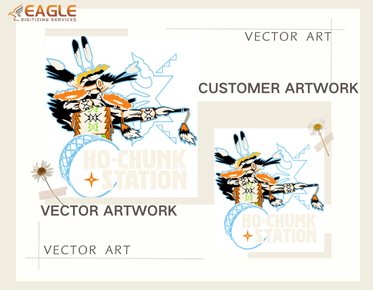
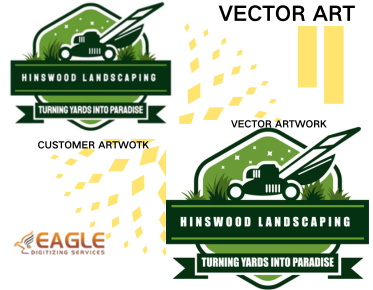
At Eagle Digitizing, high-quality vector files are created to meet professional standards. Their vectorizing services ensure that each element is meticulously crafted to ensure optimal performance in any application, from marketing materials to screen printing. This includes precisely structured layers, optimized paths, and well-defined colors, which are crucial for efficient and scalable design work.
Looking Ahead: Improving AI Vectorization
As AI technology continues to evolve, there is significant potential for improving how AI processes and outputs vector files. Innovations in machine learning algorithms are expected to better mimic human interpretation of complex designs, reducing errors in paths, points, and colors. Increased collaboration between AI developers and graphic designers could lead to tools that provide more control over the vectorization process, achieving both accuracy and efficiency.
Engaging with the Future
The journey towards more reliable AI-generated vector files is ongoing. As this technology matures, it will likely reshape how designers and printing professionals approach the task of vectorization, offering a dynamic tool that balances automation with the intricacies of human design sensibilities. What might be the future role of AI in your design or printing workflow?